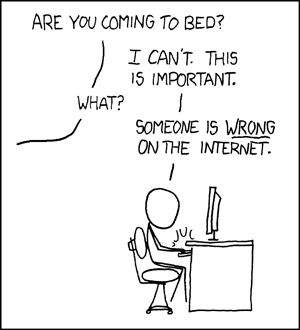
A Visual Summary of my Thoughts on the Continued Harhoff/Meron "scandal"

This is arguably my shortest blog post ever, but, in addition to my more lenghty thoughts on the subject (here and here), I wanted to share my feeling about a lot of what has been written, and continues to be written on the Harhoff storm in a teacup.

H/T to Jens for mentioning the existence of this cartoon and to Thomas for sending it to me.

Follow up on the reactions to the Harhoff letter

[The first part of this post is here]

The letter by Judge Harhoff alledging that the President of the ICTY, Judge Meron, was acting on orders from the US in recent aquittals, or at least adopting legal positions to support US positions, has received some commentary since it was made public yesterday, from blogs such as this one and EJIL Talk!, but also in the New York Times, where an article reveals that a number of officials and judges at that ICTY share Judge Harhoff’s skepticism and doubts about Judge Meron, to the point where another candidate has come forward to oppose the re-election of the latter at the Presidency. If these claims by the NY Times article are true, it seems that, if anything, Judge Harhoff has opened the floodgates of violating confidential information at the ICTY. Again, I don’t know if this is a good or bad thing, but it finally gives outside observers something concrete to work with.

But, in relation to the substance, none of the comments I’ve read so far actually bring me any closer to knowing what went on. I’m seeing language typical of conspiracy theories: “hopefully we’ll get evidence, and if there is no evidence, that means that someone is hiding things from us”. It’s a win-win situation for the conspirationists, because evidence either way can be construed as evidence of the existence of the conspiration. Also typical, is that there is a subtle shift of the burden of proof, as if those who don’t buy into the conspiracy have to bring elements to disprove it. That’s not how things should work. How do you prove that a spaceship did not land somewhere in the desert in the 1960s, leading to unhealthy experiments on alien beings?

In light of this, the only reasonable thing to do would be to just stop speculating until something concrete, other than a mere moral bias on the part of the critics (often relying on a somewhat simplistic, if not plainly wrong, analysis of the preceding case law), is revealed.

This being said, and because the temptation is just too big not to continue to debate pointlessly about this issue, I want to just share three thoughts that came up from reading the NY Times article.

First of all, there is the idea that there is a shift towards more deference to the military in the interpretation of the law in recent decisions. That might be true, but I would say that the anomaly was the previous shift away from that. For many years now, Human Rights activists have managed to convince way too many  people that International Humanitarian Law was merely a wartime branch of human rights law aimed only at protecting civilians, to the exclusion of any other consideration. But that was never true. IHL has always been a balance between the protection of non-combattants and military necessity. Forgetting the second branch of the balance has led to what Darryl Robinson has perfectly and brilliantly described as the identity crisis of international criminal law. In my view, it is therefore those who orchestrated that shift that had a political agenda, rather than those who would be returning this law to the traditional balance at the heart of IHL.

Second of all, there is this double idea that things didn’t go well in Simatovic, because Judge Picard was not given enough time to write her dissent and because Orie was alledgedly also under influence. These are two different things. The first one is testimony, if true, of the fact that the ICTY has been under pressure, notably from the Security Council, for some years now to wind down its activities through the implementation of a rigorous completion strategy. And commentators have not generally been complaining about that. On the contrary, the ICTY has been regularly faulted for taking way too long to go through the trial process and the judgment drafting. It might be unfair that some judges today have to speed things up because previous generations of their colleagues were moving along at a leasurely pace, but I don’t see the link with the issue at hand. As for Judge Orie, it should be pointed out that he appended to the Simatovic Judgment a rather surprising separate opinion that responds directly to Judge Picard’s dissent and defends the majority judgment. I find this practice a little puzzling, but, beyond that, if Judge Orie was really under external pressure, why would he do that? It is one thing to give in to the pressure in the majority judgment, it is another entirely to go out on a limb to actually write a separate opinion with his sole name on it to defend the majority. This seems to indicate that, whatever one thinks of the majority Judgement, Judge Orie sincerely believes in it.

Finally, I am once again appalled at the narrative being constructed at the moment of the ICTY being a lenient court letting “murderers” get away. That is simply not true. On a long term perspective, the ICTY case law has developed principles that cast the net very wide, rather than very narrowly, through, for example, Joint Criminal Entreprise, command responsibility, or the adoption of rules of evidence that would make any national criminal lawyer laugh and cringe at the same time. Even in the short term,   nobody seems to recall that just a few weeks ago, the ICTY found 6 defendants guilty in the Prlic case, with a strong dissent from the Presiding Judge on the lack of evidence of a Joint Criminal Entreprise. Why is nobody talking about that?

At the end of the day, if we strip away the argumentative niceties and the unsubstantiated conspiracy theories, there remains a rather mundane, but fundamental dimension on international criminal justice: its bias towards convictions and the blatant disrespect for the rights of the defense and the principle of legality. When I hear certain people talk about international criminal justice, I sometimes wonder why they bother advocating for international criminal courts at all, when they seem intimately convinced that all defendants that will appear before them are necessarily guilty. I would have more respect for these activists if they stopped pretending to have a liberal agenda and clearly stated that we should dispense with the whole masquerade that are international trials to directly go to the sentencing phase, where the bad guys will finally get what they deserve.

Some Thoughts on The bombshell Letter by Judge Harhoff at the ICTY

[The follow up of this blogpost is here]

The news has spread since this morning like a virus. A Danish newspaper has revealed the existence of a letter sent to a list of 56 (!) friends by Judge Harhoff, a siting judge at the ICTY, claiming that the recent acquittals at the ICTY (Gotovina, Perisic, Stanicic and Simatovic) are the result of political pressure exerciced by the US and Israel on the American President of the Tribunal, Judge Meron, who in turn alledgedly influenced his fellow judges to increase the threshold of complicity so as to make convictions more difficult.

This letter is obviously incredible and brings up some thoughts on a number of levels.

  • On the actual existence of the letter

First of all, if Judge Harhoff thought that this “confidential” message sent to a select number of his friends would not be made public, it shows a certain naivety. Moreover, one can question the propriety of such a letter. It seems to reveal internal information to the tribunal, in terms of the relationship between the judges that are most likely not meant to be made public.

This being said, the letter is obviously a useful tool for outside observers who rarely have access to publicly available information on the international dynamics within the tribunals, more specifically on the relationship between judges. In that sense, while probably formally improper, the letter is a welcome addition to anyone trying to understand how international criminal justice actually works, beyond the legal discussions on its output.

  • The content of the letter
I will not delve into the actual substance of the debate on the “specific direction” test that is at the heart of the current controversy. Manuel Ventura published his take on this earlier this year on this blog, and the debate has been sparked up over at Opinio Juris, with recent posts by Kevin John Heller and James Stewart. I think it’s ultimately a normative choice, with both sides having legitimate points to make.
I do however think that we need to distinguish the several dimensions of the allegations. 
The first one seems to be that some major powers have been putting pressure on Meron to interpret the law in such a way that some conduct not be regarded as complicity. I must admit that, probably naively, I don’t quite buy it. The case law of these tribunals has, over the past 20 years, adopted a number of expansive interpretations of ICL to expand criminal liability of commanders, whether through the removal of causation in command responsibility or of course the creation of Joint Criminal Entreprise. This case law never bothered anyone at the state department, despite the impact that it could theoretically have on the criminal responsibility of commanders. But of course, if there is any evidence of “specific direction” (pun intended) from some countries to their judges to apply the law in a certain way, this would be contrary to the rule of independence and impartiality of the judges and would arguably warrant sanctions.
A second, somewhat different angle, is that of Judge Meron trying himself to change the judicial policy of the tribunal on those matters. If that is what happened, I don’t see the problem, to put it bluntly. How is this any different than Cassese influencing the judicial policy of the tribunal with Joint Criminal Entreprise? Both have a normative agenda, and I refuse to take sides, on principle, between competing normative agendas, because one of them would be labelled as “moral” (i.e, good) while the other would be labelled as “political” (i.e, bad). The reason nobody was complaining at the time is of course that it is ok to stretch the law and the principle of legality and to have a normative agenda if the result is to put the bad guys behind bars. It suddenly becomes shameful when the result is acquittals. [CLARIFICATION: I’m not saying that I believe that Meron has a political agenda. I’m saying that even if he does have one, I don’t necessarily see the problem. As others have argued (see UPDATE 2 below), the “specific direction” test predates by many years the current cases and it is not at all evident that Meron does in fact have a political agenda].
A third dimension is the alleged influence of Meron on other judges. This for me is the most hypocritical argument made in the letter. Of course judges influence other judges. That is the nature of deliberations and the reality of the tribunals. The history of ICTY benches is a history of some extremely competent people, but also a history of judges with serious deficiencies in character and in competence on issues of international law and international criminal law. Who could seriously claim that Antonio Cassese did not put “pressure” on some of his fellow judges to obtain certain things in judgments? Who could seriously claim more generally that deliberations are perfect egalitarian foras where the perfect legal truth emerges form pure argumentation? All deliberative bodies are the scene of power struggles, personal animosities and friendships which necessarily influence approaches to the substance of issues discussed, back-door compromises and negotiations. I don’t see why ICTY Chambers would be any different. Once again, I did not hear Harhoff complain in the past of the possible intellectual influence of some judges over others.

  • the impact of the letter
It is difficult at this point to gauge the possible impact of this letter, other than getting the little world of ICL commentators excited. In relation to Perisic and Gotovina, I wonder if there is any room for the Prosecutor to request a reconsideration of the Appeals Judgments in light of the allegations by Judge Harhoff. My sense is that, absent specific evidence of lack of impartiality on the part of Meron, this would be bound to fail. Also, it is possible that the Prosecutor will bring these issues up in the Simatovic appeal, maybe to ask for the removal of Judge Meron (and Gunay?) but again without concrete evidence, I don’t see this going very far.
What about the impact on the outside world? Some might think that the legitimacy of the tribunal would be affected by such allegations. I really don’t think so. First of all, the internal workings of the tribunal are, let’s be honest, of interest to only a limited number of Hague nerdish commentators. Second of all, those who already think that the tribunal is illegitimate, will only think that their fears are confirmed. The affected communities never had much faith in the institution in the first place, and I don’t see these new accusations as changing anything. The only community that might be concerned is the community of human rights activists, who, as Judge Harhoff, frown upon anything that might stand in the way of “ending impunity”, be it politics, the rights of the defense or the principle of legality. 
Finally, what could be the consequences for Judge Harhoff himself? I can’t see this being pushed under the rug. He is currently sitting on the difficult Sesejl case, but it is difficult to know if there is any link with the current debate until the judgment is issued. On a general level, there doesn’t seem to be much respect on the part of the judge for the presumption of innocence, as he seems to have preconceived ideas about who should be found guilty or not. More generally, Judge Harhoff has explicitly singled out some of his colleagues and I can’t see how this can make his work at the ICTY possible. A French politician some years ago said that a government minister should either shut up or get out if he disagrees with his government. I’m wondering if this should not apply to Judge Harhoff as a natural consequence of his doubts, whatever one thinks of them.

UPDATE 1: Over at EJIL Talk!, Marko Milanovic thinks that this is the “worst scandal to engulf the ICTY in its history”. I’m really not that sure that it will be and if it really does turn out to be, I think it means that people seriously have their priorities wrong in what they should be focusing on in the work and output of the ICTY.

UPDATE 2: This recent blogpost over at Balkan Insight sheds some light on the fact that if there is a conspiracy theory, the case needs to be made in a far more convincing way given, among other things, the past use of the “specific direction” test in the case law. Ivanisevic argues rather convincingly that what has changed is not the political policy, but rather the fact pattern.

The Comoros Referral to the ICC of the Israel Flotilla Raid: When a ‘situation’ is not really a ‘situation’

As has been widely reported already, The ICC OTP announced today that it had received a referral from the Comoros “in relation to the event of May 2010 on the vessel Mavi Marmara”. You will recall that this boat was part of the group of boats that tried to reach Gaza at the time and which were boarded by the Israeli army, resulting in a number of deaths and injuries.

The usual suspects of the blogosphere have already put up excellent posts on this development: Kevin Heller (here and here), Dapo Akande (here) and William Schabas (here). They already covered a number of more political issues which I won’t delve into here, such the perception issues that would flow from the initiation or not of a formal investigation among African States and the international community, the alleged anti-palestinian bias of the ICC OTP or the apparently poor timing of the referral given that Israel and Turkey seem to be getting close to finishing their negotiations on the incident.

I also won’t go discussions of certain legal questions that come up in relation to this referral. I would tend to agree with Kevin’s evaluation that this would not meet the gravity threshold under Article 17, especially given the response given by the Prosecutor in the Iraq communications. However, I’m wondering if the Abu Garda case, which concerned a single attack on a peace keeping compound, and where it was considered that the gravity threshold was met, is not a indication to the contrary.

Also, I find the referral thoroughly sloppy on the legal characterization of the facts as war crimes and crimes against humanity. It unconvincingly tries to link the events to the Gaza situation (discussions on the Palestinian declaration to the ICC in 2009 are for me beside the point here) and there is a meager two paragraphs on crimes against humanity that would be laughable if not present in a formal State referral to the ICC.

Finally, as an aside, I think too much is being made of the link between the fact that Comoros is the State of registration of the Mavi Marmama and the fact that Comoros is doing the referral, as if the former implied the latter. However, legally, there is no need to make that link. What’s important is that the alleged crimes were committed on the territory of a State Party, but after that, any State Party could have made the referral.

But the main point I want to focus on is whether this is really a referral of a “situation” as required by the ICC Statute. Both Dapo and Kevin make strong cases on the fact that this is indeed a “situation”, because specific cases have not been referred (which would not be allowed) and because it is not an issue that potentially only one crime has been committed (I’m not entirely sure why both of them make this last point so vocally, as even the referral suggests, even unconvincingly a number of alleged crimes falling within the jurisdiction of the Court…). I’m still not convinced for the following reasons.

To start out, it is interesting to note that, reading the referral, the scope of the “situation” that is referred is subject to interpretation. The Mavi Marmara is mentioned a number of times in the document, but the actual referral seems to be broader and cover “IDF’s attach on the humanitarian aid flotilla on the 31st of May 2010”. This ambiguity is reflected in the OTP Press release with only mentions the Mavi Marmara in the title of the release, while using the broader scope in the text of the release.

I think both interpretations raise different questions that I’m struggling with.

If the situation referred is the attack on the Mavi Marmara, I can’t shrug the feeling that this is stretching the notion of “situation” a little too far. Of course, a “situation” needn’t be the whole territory of a State (as illustrated by the Uganda and Sudan referrals). However, I’m wondering if narrowing down a referral to a single event doesn’t make a joke out of the whole idea of what a “situation” is (as well as of prosecutorial discretion in the selection of cases). Would we really call, for example, the “referral” of the destruction of the bridge of Mostar or the Sarajevo snipping, “situations”? Or to take an ICC example, what would we have said if only the attack on the AU peacekeepers, for which Abu Garda was charged, had been referred by the Security Council?

Moreover, the thin line between “situation” and “case” becomes a little blurred if this referral is accepted. Indeed, at the ICC, a case is when, within a situation, a specific individual becomes the focus of investigations for specific crimes.  For me, allowing only one incident to be referred under the label “situation”, would be like saying in a national context that investigation into a murder is a “situation”… until a suspect is identified and it becomes a “case”. This would be a ridiculous semantic distinction. In other words, I think that we are here very close to a “case” being referred to the ICC. This feeling is obviously strenghtened by the fact that the perpetrators are already know and pointed to in the referral, at least collectively, as the IDF.

Let me be clear, I’m not saying that this referral does not fit the ICC definition as it currently stands and as put forward by Dapo and Kevin (given that it is extremely vague both in the Statute and the case law…), but should this be considered as a “situation”, thus allowing the ICC to take on specific incidents, rather than broader “situations” (for lack of a better word…),  I think this could change the logic of ICC intervention in ways that would not be necessarily welcome.

If, on the other hand, the “situation” is the attack on all the boats, notably the two other ships flying flags of State Parties (Greece and Cambodia), then a different question arises. The issue can become whether the referral is too broad rather than too narrow. Indeed, the referral covers crimes committed not on the territory of one State Party, but on the territory of several State Parties. Again, nothing in the Statute seems to prevent that, but I’m wondering if this is really what the drafters intended, because it could lead to the consequence of actually de-territorializing.

Indeed, what the Comoros are essentially saying, is that the key element is the attack and its perpretrators, irrespective of the territory it was committed on (aside from the jurisdictional requirements of course). This means that tomorrow, a State could refer the crimes committed by a global terrorist organization, anywhere on the territory of a State Party. Would that fit our instinctive notion of a “situation”? If it doesn’t, we must be cautious at accepting a referral which does the same here: the attack of the IDF on the flotilla, irrespective of the territory it was committed on. I know it seems difficult to compare the two situations, because we are just talking about boats here, not entire countries, but legally, it’s the same difference.

All in all, I think that the fact that this is a “situation” under the Rome Statute is not as clear-cut as we would like to think. And if it turns out to be, I think it sets a precedent that can have far-reaching consequences that we should be aware of and that might affect the way the ICC operates in ways that go further than the specific political context in which this referral comes.

Guest Post: What the ICTY appeal judgment in Perišić means for the SCSL Appeals Chamber in Taylor


I’d like to begin by thanking Dov for giving up the space on his blog to allow me to post the following thoughts on the Perišić appeal judgment as it relates to Charles Taylor’s pending appeal at the Special Court for Sierra Leone.

During the closing trial arguments in the Perišić case, the following memorable in-court exchange was recorded between Presiding Judge Moloto and Senior Trial Attorney (now Co-Investigating Judge at the ECCC) Harmon. It is quoted at length because it goes to the very heart of why the Appeals Chamber overturned the convictions of Perišić – the highest ranking Yugoslav military officer during the time of his indictment – for aiding and abetting crimes committed by the VRS (Bosnian Serb Army) through the provision of substantial military support and assistance:

Judge Moloto: [M]y question is what is the authority for the proposition that, if an army assists another army in war and crimes are committed of the nature that are charged in this indictment, that the assisting army or commander of the assisting army is guilty of aiding and abetting those crimes?
Mr. Harmon: Your Honour, General Perišić provided assistance knowing that that assistance was going to assist the VRS [Bosnian Serbs] and it was likely that that assistance would be used in the commission of crimes.
Judge Moloto: Okay. Let me paint you an analogous scenario and get your comment on it. A war began in Afghanistan in 2001 and it is generally known that there are allegations of crime having been committed at least since 2002 to date. Does that make the commanders of the various NATO armies that are jointly participating in that war guilty of the crimes that are alleged to have been committed, and are still being committed, like detentions in Guantanamo, in Bagram, in Kabul and all these places?
Mr. Harmon: Your Honour, you are asking me obviously, an explosive political question.
Judge Moloto: No, no. It’s a legal question.
Mr. Harmon: I would like to answer your question. The objectives, as I understand, of the NATO forces isn’t to ethnically cleanse parts of Afghanistan. It is to be engaged in a military campaign against the Taliban. It is —
Judge Moloto: Mr. Perišić is not charged with ethnic[] cleansing. He is charged with murders. That’s why I’m making the distinction between the actual crimes that are charged in the indictment. […]
[snip]
Judge Moloto: […] [M]y question still stands, […] – what is the authority for that proposition and I’m saying can you comment on the – on the analogy that I’ve drawn because all the other commanders of the NATO nations that are involved in Afghanistan are aware of the kind of crimes that have been committed there and are still continuing with that war. It’s not a political question, it’s an analogous situation to this one.

Mr. Harmon: I draw the distinction as I say, as follows, Your Honour, the first situation is it’s a war, it’s a war in Bosnia and it was a war in and it is an on-going war in Afghanistan. Where I make my distinction is the purpose in objectives. The objectives of Bosnian Serbs, in part of strategic objective number 1, was to ethnically cleanse, if you will, that is a much broader term, it was to separate the Serbs from the non-Serbs. That act gave rise to conduct, long-standing conduct that lasted throughout the war of the VRS taking populations of Muslims and Croats and removing them from their homes by force. That was no mystery. General Perišić was aware, as we say in our brief, was fully aware of the conduct of the Bosnian Serbs, and with the knowledge of that conduct he provided them with assistance that enabled them to continue to conduct the war, continue to commit crimes, and that assistance that he provided had a substantial effect on the commission of those crimes. So I make a distinction between the Afghan war, where there is not the stated purpose which is to remove and ethnically cleanse. I also make one other observation about the Afghan war. In the Afghan war, and I’ll take the United States as an example, because I’m familiar with the United States’ participation in part in that. When there were crimes that were committed by American soldiers, those crimes were prosecuted in the United States and people are serving life prison sentences as a result of those crimes committed against Afghan civilians. In this situation, there were no prosecutions whatsoever, either in the VRS or in the Federal Republic of the Yugoslavia for war crimes.
[snip]
Judge Moloto: You see, unfortunately, we don’t seem to be on the same wavelength. […] [T]he point I’m asking simply is because the armies, the commanders of the remaining NATO countries that are participating in Afghanistan are aware of the fact that crimes have been committed, crimes against humanity have been committed, and yet those commanders are still continuing to participate in that war, are they then guilty of those crimes that are being committed? That’s just – you either say they are not guilty or they are guilty. If anybody is guilty of those crimes, then they are equally guilty with those people of those crimes, because they are aware of those crimes being committed and yet they are continuing to participate in that war.
Mr. Harmon: I draw a distinction, Your Honours, between continuing to participate in the war. The position we assert here is identical to the situation in your hypothetical situation.
[snip]
Judge Moloto: And, therefore, if it is identical, then you are saying, yes, they ought to be guilty if anybody else is guilty.
Mr. Harmon: Your Honour, I don’t want to go that far. I’m saying that the situation is identical in terms of the framework of our case.
Judge Moloto: I won’t force you to go any further than that.


(The full exchange is available on the ICTY’s YouTube channel: http://www.youtube.com/watch?v=6Cfbt_mQ-rw(beginning at 8:43))

In the end, Perišić was convicted of aiding and abetting crimes committed by the VRS (Bosnian Serb Army) – held to be a separate army from that of Yugoslavia – because his provision of substantial military and logistical support was made with the knowledge of their pattern of criminal behaviour and the likelihood of further crimes being committed. (Perišić was also convicted, as a superior, for crimes committed by the SVK (Croatian Serb Army), but this post will not delve on these convictions (which were also overturned on appeal)). Judge Moloto dissented, for essentially the reasons that are apparent in the above exchange. In his view, the majority’s decision outlawed the waging of war: the mere provision of assistance to another army’s war effort was too remote from the crimes committed during such a conflict to qualify as aiding an abetting (Perišić, Trial Judgment – Dissenting Opinion of Judge Moloto, para. 3).

On 28 February 2012, the Appeals Chamber, in effect, sided with Judge Moloto. It did so on the basis that ‘specific direction’ is an element aiding and abetting and must be explicitly established, particularly where the accused is geographically distant (like Perišić was) from the perpetration of crimes (Perišić, Appeal Judgment, para. 75). In the words of the Appeals Chamber:

[I]n most cases, the provision of general assistance which could be used for both lawful and unlawful activities will not be sufficient, alone, to prove that this aid was specifically directed to crimes of principal perpetrators. In such circumstances, in order to enter a conviction for aiding and abetting, evidence establishing a direct link between the aid provided by an accused individual and the relevant crimes committed by principal perpetrators is necessary. (Perišić, Appeal Judgment, para. 44)
The contrary position had been taken by the Perišić Trial Chamber on the basis of the ICTY Appeals Chamber’s judgment in Mrkšić and Šljivančanin, which was found to have not said what it clearly did: that specific direction was not an element of the actus reus of aiding and abetting (Mrkšić and Šljivančanin, Appeal Judgment, para. 159). This was found to be the case because Mrkšić and Šljivančanin had only said this in passing, in a section dealing with mens rea, was not relevant to their holdings in that case, did not explicitly acknowledge departure from prior precedent (which had in fact, said the opposite), and had only cited to one previous judgment (which it had misread) (Perišić, Appeal Judgment, para. 35).

That specific direction was not an element of the actus reus of aiding and abetting had been crucial for Perišić’s conviction. It meant that the Trial Chamber did not need to show that, alongside his substantial assistance to the VRS, his knowledge of their criminal acts and the likelihood of the further commission of crimes, his actions were designed to specifically aid them. It must be emphasised here that the VRS was not found to be a criminal organization – it conducted its military campaign using both lawful and unlawful means.

The Perišić Appeals Chamber could not find, among the various factual findings of the Trial Chamber, that the military aid and logistical support had been specifically directed towards the VRS’ criminal actions rather than simply supporting them in the armed conflict. Thus, Perišić’s knowledge of the VRS’ criminal behaviour was rendered moot. His convictions for aiding and abetting were overturned.

In other words, what would have distinguished Judge Moloto’s Afghanistan hypothetical was that NATO’s support of the war effort was not specifically directed to the commission of crimes (either in Guantanamo, Bagram or Kabul). Such support alone therefore did not render NATO military commanders criminally liable – as aiders or abettors – for the (alleged) crimes committed therein.

What does this have to do with Charles Taylor at the SCSL?

The answer, is that it has everything to do with Taylor. This is because half of all his convictions (Taylor, Trial Judgment, para. 6994(a)) were for aiding and abetting the various crimes committed by Revolutionary United Front (RUF) and the Armed Revolutionary Council (AFRC) in Sierra Leone through his provision of arms and ammunition, military personnel, operational support and moral support (Taylor, Trial Judgment, paras. 6910-6915, 6918-6924, 6927-6937, 6940-6946). Like Perišić, Taylor, as President of Liberia, was geographically distant from the crimes on the ground (he claimed during the trial that he had never set foot in Sierra Leone). How did the SCSL Trial Chamber deal with aiding and abetting, specifically, the issue of specific direction? According to the Chamber:

The actus reus of aiding and abetting does not require “specific direction”. (Taylor, Trial Judgment, para. 484)

The accompanying footnote (Taylor, Trial Judgment, fn. 1141) refers only to the trial judgment in Perišić and the appeals judgment in Mrkšić and Šljivančanin, both of which have now been destroyed by the PerišićAppeals Chamber. Curiously, (but understandably) there is no mention of the Taylor trial judgment in the Perišić appeals judgment.

Thus, the Taylor Trial Chamber, like the Perišić Trial Chamber, did not need to show (and did not in fact show in the section assessing his aiding and abetting liability – see Taylor, Trial Judgment, paras. 6910-6915, 6918-6924, 6927-6937, 6940-6946) that Taylor’s aid was specifically directed towards the crimes of the RUF and the AFRC, but it did so on the basis of (now) erroneous ICTY jurisprudence.

So where does this leave half of Taylor’s convictions on appeal?

As a result of the Perišić appeal judgment there are now only two realistic possible outcomes with respect to specific direction (if the factual findings are left largely undisturbed): 1) the Taylor Appeals Chamber concurs with the Perišić Appeals Chamber, or 2) the Taylor Appeals Chamber picks a fight with the Perišić Appeals Chamber.

With respect to the first option, it is critical for the TaylorAppeals Chamber to find that Taylor gave more than just general support to the RUF and the AFRC. Such assistance must have been specifically directed to the relevant crimes. And this must be found in amongst the longest judgment in international criminal law history. If it cannot be found, then it is game over. Taylor must be acquitted of all his aiding and abetting convictions.

With respect to the second option, the Taylor Appeals Chamber is of course not bound by the decisions of the ICTY, and can in fact find support in the separate and dissenting opinions of the Perišić appeal judgment (see in particular Perišić, Appeal Judgment – Partially Dissenting Opinion of Judge Liu, paras 2-3 and Separate Opinion of Judge Ramaroson, paras 2-6(in French) (both opining that specific direction is not an essential element of the actus reus of aiding and abetting). But should the SCSL go down this path and split with the ICTY, it would mean yet more (!) fragmentation in international law and it would (re)invite the problems that Judge Moloto alluded to in his exchange with Prosecutor Harmon.

In the alternative, it could side with Judges Meron and Agius, who suggested that specific direction should be an element of the mens reaof aiding and abetting, not the actus reus (see in particular Perišić, Appeal Judgment – Joint Separate Opinion of Judges Meron and Agius, paras 2-4). Nevertheless, even they conceded that specific direction could reasonably be assessed in the actus reus context and refused to depart from previous jurisprudence.

Of course, the ‘wild card’ option would be to order a retrial, but that is unlikely given where the SCSL is in its lifespan.

Will half of Charles Taylor’s convictions be overturned on appeal because of the Perišić appeal judgment? Time will tell…